
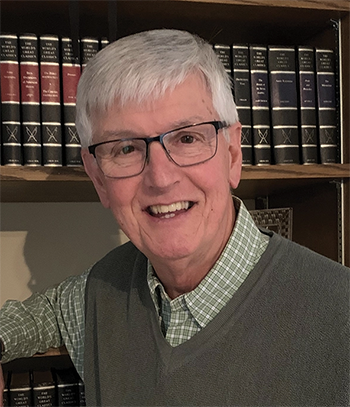
Throughout his nearly four decades of practicing internal medicine in Kalamazoo, James Carter, MD, had his fair share of tough days on the job.
To help him process those difficult moments, Dr. Carter turned to photography.
“Art was the way I cleared my brain after a hard day,” Dr. Carter said. “Particularly in times of stress, I found that doing my art, photography, allowed me to express my feelings in a way that words could not.”
Dr. Carter practiced internal medicine for 36 years in Kalamazoo, also serving as an associate professor for Michigan State University College of Human Medicine (MSU-CHM) and program director for the Internal Medicine residency program at Michigan State University Kalamazoo Center for Medical Studies (MSU/KCMS), the predecessor to WMed. For more than four decades, Dr. Carter has also maintained a strong relationship with the Kalamazoo Institute of Arts (KIA), taking classes, serving on the board of directors, and, currently, serving as a docent at the museum.
In November, Dr. Carter visited the W.E. Upjohn M.D. Campus to give a talk, “The Value of Art in Medicine,” as part of the Department of Medical Ethics, Humanities, and Law Tuesday Seminar Series. During his presentation, Dr. Carter outlined how the visual arts in particular are beneficial in the context of medical education, as they help medical students improve their observation skills and communication skills, and can help reduce burnout, among other benefits.
“The visual arts are just a great avenue for discussing ambiguity,” Dr. Carter said. “I’ve found when I’ve had medical students with me in the art museum that it’s a great place to talk about compassion and empathy. It’s also a great place to talk about some of the difficult things like end-of-life talks. It’s a safe environment.”
Each year during Match Week, Dr. Carter leads a group of M4 students from WMed on a guided, reflective tour of the KIA. During the tour, Dr. Carter works with students on their communication and observational skills through a variety of exercises, one of which begins with students looking at a painting or photograph silently for two minutes.
“Each student will then write a phrase, something that strikes them about the photograph, without discussion, without talking to each other,” Dr. Carter said. “Then, we put it together as a poem. Some of the poems have been phenomenal. The students really enjoy the experience.”
Dr. Carter said he’s grateful to be able to offer these experiences to medical students, noting the importance of passing on knowledge and skills to the next generation of physicians.
“As long as I’m able, I’m going to do this for the students. There’s absolutely no doubt about that,” Dr. Carter said. “It’s important for them, and it’s important to me, too. I’ve been an educator all my life. I came here as the program director and ran the program for a number of years. The education of our young students is important, but it also gives me hope. Working with the students has been very uplifting.”