
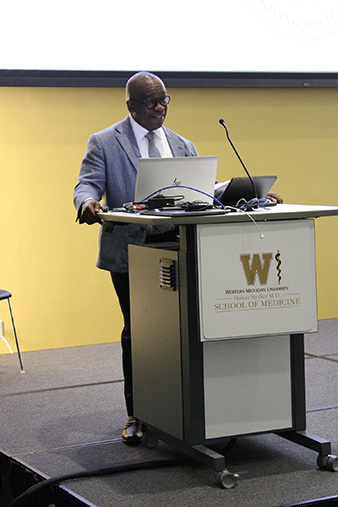
J. Adrian Tyndall, MD, MPH, FACEP, the Hal B. Jenson, MD Dean, President and CEO of WMU Homer Stryker M.D. School of Medicine (WMed), welcomed donors to the W.E. Upjohn M.D. Campus to highlight the many ways their support is fueling the medical school’s mission, vision, and helping impact the communities it serves.
“I firmly believe we are on the right road,” Dr. Tyndall told the crowd that gathered on Thursday, November 19, in the William D. Johnston and Ronda E. Stryker Auditorium for the Dean’s Circle Leadership Giving Society Annual Reception. “I’ve been excited about the last eight months that I’ve been here. This has been a fabulous opportunity but it’s made possible by all of you, it’s made possible by the donors in this community, those who celebrate their chronic conditions of giving.
“It really is a celebration of the momentum we have and the specialness of this institution,” he added.
The Dean's Circle Leadership Giving Society includes a special group of donors who are leaders in supporting WMed with annual gifts of $1,000 or more. Those gifts help support the Dean’s vision and strategic priorities for the medical school, provide enhanced educational opportunities for students and resident physicians, and advance the overall mission of the medical school.
The Dean's Circle Leadership Giving Society includes donors who are leaders in supporting WMed with annual giving, endowment donors, planned giving donors, and donors who have supported WMed significantly over the course of their lifetime. Those gifts help support the Dean’s vision and strategic priorities for the medical school, provide enhanced educational opportunities for students and resident physicians, and advance the overall mission of the medical school.
At the donor reception, the work being done in the community through the Street Medicine Kalamazoo (SMKzoo) initiative at WMed was highlighted by M4 Karli Crouch, M3 Ethan Poupard, and M2 Hannah Walker. SMKzoo, which was started in 2021 by students, residents, and attending physicians from the medical school, provides healthcare services for people who are unhoused, meeting them where they are and caring for them with compassion and respect.
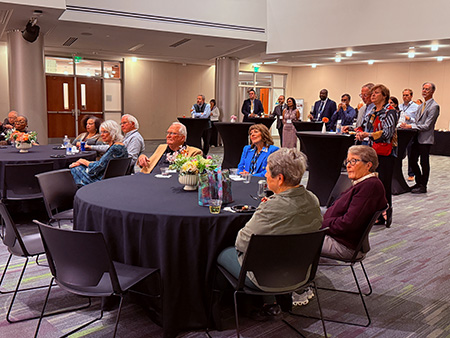
Dr. Tyndall told donors that WMed is “very unique” and does things differently from other institutions as a community-based medical school. And that work, he said, is more important than ever “as the winds of academic medicine are changing.”
With that in mind, Dr. Tyndall said two important priorities at WMed will be finding ways to drive and create pathways for students from our community who want practice medicine in in Southwest Michigan, as well as a focus on recruiting and retaining talented faculty.
“Medical schools thrive because of great people – great faculty, tremendous community members who support that faculty – and we are interested in ensuring that we can recruit and retain terrific people,” he said.
“There’s no question in my mind that we are entering uncertain times – uncertain times in funding, uncertain times in how we support our academic missions,” Dr. Tyndall said. “But what I’m resolute on is that we have the community, we have the people, we have the skill set to help us move through that process. In the next several months we will be focused on a strategy that will help guide us to what WMed needs to be in the next 10 years. We will be presenting that vision to all of you and in that vision is a sense that in order to do this we need all of you.
“We need our community members, we need our donors, we need your help in really recruiting the next generation of providers and physicians who will serve this community and then eventually we’re going to be able to get to the point of really addressing what is going to be really important to us which is health equity,” he added.
Contact the Office of Development at giving@wmed.edu for more information about how you can support the medical school by making a gift or becoming involved in our efforts, or visit wmed.edu/deanscircle to learn more about the Dean’s Circle Leadership Giving Society.