

New first-aid equipment at WMU Homer Stryker M.D. School of Medicine (WMed) is better positioning faculty, staff, residents, fellows, and students to respond in the event of excessive bleeding.
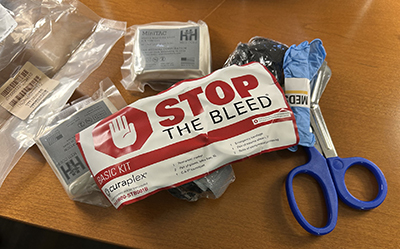
Stop the Bleed kits are now available for use at the W.E. Upjohn M.D. Campus and are located alongside the Automated External Defibrillator (AED) equipment near the tower elevator on all occupied floors of the building. Additional kits will be deployed at other WMed campus locations soon, according to Paul J. Schenarts, MD, FACS, MAMSE, professor in the Department of Surgical Sciences and Associate Dean for Faculty Affairs at WMed.
“The leading cause of traumatic death is bleeding, and the leading cause of preventable death is bleeding from an extremity,” said Dr. Schenarts, who led the effort to bring Stop the Bleed kits to WMed. “This equipment has proven to really save lives, and these kits have been very, very successful in achieving better outcomes for bleeding patients.”
Thirty percent of states require Stop the Bleed kits in schools and all public places, and another 30% have legislation pending, Dr. Schenarts said. While Michigan does not currently have such a requirement, he felt it was critically important to provide this equipment at WMed and to educate faculty and staff on how to use it.
“There's a time between the injury and when the ambulance arrives, and in that time frame, if things are going bad really, really fast, you have to be able to act and to do something,” Dr. Schenarts said. “Timely intervention is extremely helpful.”
Each kit includes detailed instructions, gloves, scissors, gauze, and a tourniquet to stop excessive bleeding from extremities. Dr. Schenarts plans to educate faculty on how to use the kits in future meetings and will offer further resources as needed to help members of the WMed community be capable of responding during excessive bleeding incidents.
“Hopefully, we never have to use these kits,” Dr. Schenarts said. “But should we need to, we’ll be prepared.”