
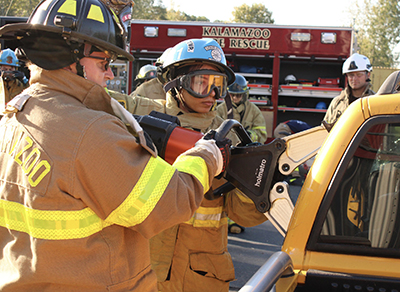
Earlier this month, the medical school’s emergency medicine residents and EMS fellows experienced firsthand some of the challenges EMS and fire/rescue personnel face in the field during the annual EMS Day at the Kalamazoo Regional Fire Training Center.
The all-day event was held Wednesday, October 7, 2026, and offered a taste of the prehospital life, with residents and fellows having the opportunity to use extrication tools, rappel from a five-story building, and practice their splinting and medical/trauma management skills.
“EMS Day allows our residents and fellows to get hands-on with the equipment that is used prehospital and allows them to better appreciate the processes that occur before patients arrive in the emergency department,” said Josh Mastenbrook, MD, associate professor and EMS Fellowship Program Director in the Department of Emergency Medicine at WMU Homer Stryker M.D. School of Medicine (WMed). “This event also helps our residents and fellows to develop face-to-face relationships with our local first responders that allow them to more effectively interact during high-stress incidents in the field.”
EMS Day represents just a sliver of the prehospital experience afforded to emergency medicine residents and EMS fellows while at WMed. Residents and fellows gain additional firsthand experience responding to EMS calls in the field through the Medical Support Units (WMed-1 and WMed-2) Resident and Fellow Physician Response Program, which places a senior emergency medicine resident physician and/or EMS fellow in a dedicated response vehicle for a 24-hour shift.
The physician response units are directly dispatched by the Kalamazoo County Consolidated Dispatch Authority (911 Center) for responses to multi-casualty incidents, cardiac arrests, significant traumas, tech rescues, and other major EMS incidents. WMed-1 is staffed 24/7/365 whereas WMed-2 is staffed based on 48 hours of EMS fellow home call per week.
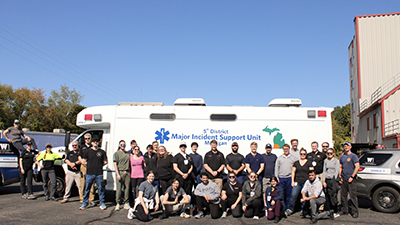
Residents and fellows are considered field medical control physicians and are authorized by the Kalamazoo County Medical Control Authority (KCMCA) to direct all aspects of prehospital care. Through the hard work and dedication of our EMS personnel and an effective EMS system design, cardiac arrest survival in Kalamazoo County is among the highest in the nation.
“Staffing the physician response vehicles, our residents and fellows gain valuable experience making medical decisions and managing patients out in the field, taking on a key leadership role as the on-scene physician,” Dr. Mastenbrook said. “This really builds their confidence in practicing medicine, and they take that valuable experience back to the hospital.”
Additionally, through a unique partnership with Yellowstone National Park, residents and fellows have the opportunity to provide 24/7 medical control consultations to the park EMS clinicians, assist with on-site continuing education, and participate in a robust quality improvement program. WMed is one of only a few medical schools in the nation to maintain an on-call emergency medicine resident physician or EMS fellow who provides medical control to EMS units 24/7.
Residents and fellows are supervised by on-call Emergency Medicine faculty, and medical control consultations locally and from Yellowstone are routed to an on-call EMS physician through a telecommunications platform. A newly acquired, sophisticated recording system allows for effective case reviews of communications between EMS field personnel and medical control physicians.
“Emergency physicians must have a solid understanding of EMS and this is best achieved through a longitudinal experience throughout residency/fellowship, rather than via an isolated rotation,” said William Fales, MD, professor in the Department of Emergency Medicine and division chief for the Division of EMS and Disaster Medicine at WMed. “We believe that EMS is best mastered by being an active participant, and our diverse set of experiences challenge our residents and fellows and instill an appreciation for the many facets of EMS that will stay with them throughout their careers.”