
Since she was a child, Marina Cox has spent her summers canoeing on the Au Sable River, paddling and navigating the waterway with her parents and her brother and sister not far from the family’s cabin in Mio, Michigan.
And for the last eight years, Cox, a fourth-year student at WMU Homer Stryker M.D. School of Medicine (WMed), and her family have made a point to catch the annual Au Sable River Canoe Marathon, an intense 120-mile canoe race that’s held every July in northern Michigan and stretches from the start in Grayling to the finish line in Oscoda.
“We watch the start every year with friends and family,” she said recently. “I always thought it was so exciting.”
Last year, as the group watched race participants run with their canoes at the start of the race, Cox pondered the idea of trading in her time as a spectator for the chance to actually race, not knowing at the time whether her schedule for her final year at WMed would afford her the opportunity.
“I told my family last year, ‘We have to do this,’” she said. “And, as it turned out, my fourth-year schedule ended up working out in June and July so I realized we could actually do it.’”
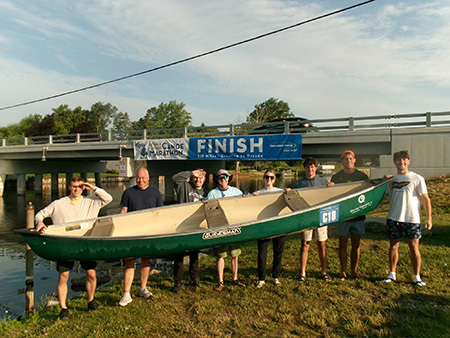
Cox, a Kalamazoo native and an alumna of Mattawan High School and Oakland University, took on the challenge with a team of seven other racers that included her father, Jim, her brother, Mason, her boyfriend, Cameron Winn, her sister’s boyfriend, Matt Dargay, her neighbors, Alec and David Ryder, and her brother’s friend, Anthony Nofs.
As first-time participants, the group entered the Consumers Energy AuSable River Challenge 120, also known as the ARC120, an amateur event that is separate from the AuSable River Canoe Marathon. While the race covers the same 120 miles as the main event, Cox said the ARC120 allows teams a longer time for completion – 29 hours – as well as the chance to complete the race in a relay format in any type of canoe.
“The amateur race started five years ago,” Cox said. “So, once I got it in my head that I wanted to do the race and found out that there was an option for beginners to compete as a relay team, I really started thinking seriously about it last year. After so many years of saying it would be cool if we did this one day, I was like, ‘Why not do this now?’”
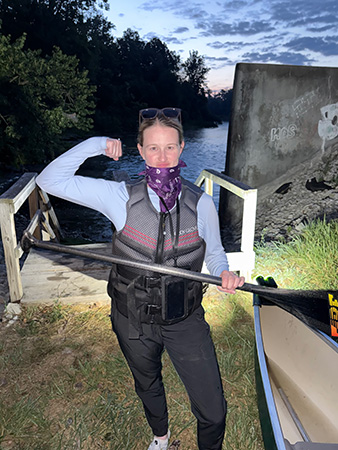
Cox said the team began training in early June with her family’s recreational canoe, not long after she completed an away dermatology rotation in Cincinnati. Cox said she helped map out the team’s strategy, figuring out which racers would be paired up during different sections of the race while taking into mind the overall weight in the boat, as well as each teammate’s physical strength and navigation skills.
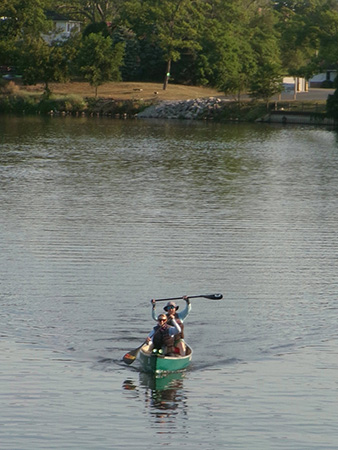
When race day came on Friday, July 24, 2026, Nofs and Mason Cox were the first duo in the canoe, setting off with 18 other canoes at 7 a.m. that day. From there, Cox said each two-person team completed 8- to 10-mile legs along the river – a trek that took about one and a half to two hours – before handing off their paddles to two teammates.
When it was their turn to catch their breath in between each leg of the race, Cox said members of the team were being shuttled in three cars to the different relay check points and keeping themselves fed and hydrated with food and water provided by Cox’s mother who served as the team’s “crew chief.”
“Our team was really awesome. We had people that were willing to get back in the canoe even if they weren’t 100 percent ready,” Cox said.
The most difficult stretch of the race proved to be during the nighttime hours, Cox said. There were stints during that time where the river widened and paddling proved difficult as the current weakened. Additionally, the team had to portage the canoe around five of the six dams that were along the 120-mile stretch in the darkness.
“We had lights on the canoe – bright lights clamped to the front – as well as headlamps but it was total darkness out there,” Cox said.
Cox said sleep was also hard to come by. She said she slept very little during her breaks outside of the canoe because she was so amped up about the race and cheering on her teammates. Despite the challenges, Cox said she and her teammates found success by supporting one another and remaining focused on their overall goal of crossing the finish line within the 29-hour time limit.
In many ways, Cox said the race shared similarities with her experience as a medical student and aspiring physician at WMed.
“I was capable of so much more than I thought,” she said. “My mind was stronger than I thought it would be, and I learned that you really have to lean on your people. When I wasn’t in the canoe, my teammates were in there giving it their best effort. We pushed and supported each other all the way to the end. The support I’ve received from my family and friends throughout medical school has been the same, and I’m so grateful to be able to lean on them through hard times.”
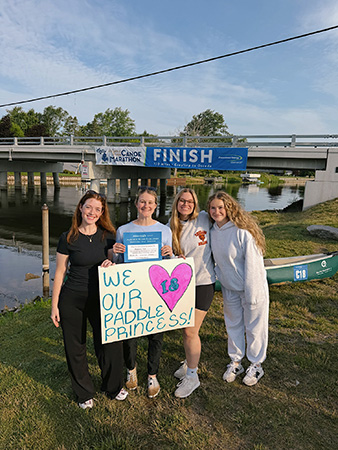
Cox said the team was able to complete the canoe race in 25 hours, well under the 29-hour limit, and crossed the finish line at 8 a.m. on Saturday, July 25. Cox and her father were in the canoe for that final stretch as their teammates, as well as Cox’s mother, her grandfather, and her three best friends and classmates from WMed – M3 Remy Gerew and M4s Skylar Ketteler and Madeline Yorke – cheered them on.
“It ended up being my dad and I who crossed the finish line which was arguably the best part of the whole race,” Cox said. “He’s the person that taught me everything about canoeing, so it was really special to be able to have that moment with him.”
More than a month removed from the race now, Cox is back at WMed and completing her core rotations, as well as additional away rotations in dermatology, a specialty she plans to pursue in residency following Match Day in March and commencement in May.
She and her teammates also have their eyes on racing in next year’s ARC120. They plan to replace their recreational canoe with a racing canoe and have set a new goal to finish the race in 22 hours.
“Being able to do the race with my family and our friends and push each other to our limits is something I’ll never forget,” Cox said. “We were so exhausted and couldn’t wait to be done, but realizing at the finish line what we had accomplished was a great feeling.
“Everyone’s on board to do it again.”