
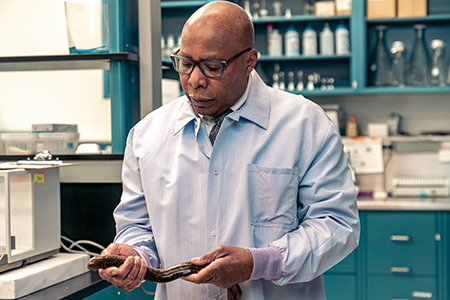
A professor at WMU Homer Stryker M.D. School of Medicine (WMed) is enlisting the help of an invasive species to further understand the effects of opioids.
Prentiss Jones, PhD, director of toxicology and professor in the medical school’s Department of Pathology, is using Petromyzon marinus (sea lamprey) to fill gaps in knowledge related to the pharmacodynamics and pharmacokinetics of opioids.
The research could not come at a more critical time as Michigan continues to grapple with the opioid crisis. Overdoses remain the leading cause of accidental death in the state among people ages 21-65 and each year opioid overdoses kill more people than motor vehicle accidents.
“There’s missing information, things we just don’t know about opioids,” Dr. Jones said. “A hallmark of opioid overdose is the profound respiratory depression it causes. What’s unique about the sea lamprey is it has a dorsal aorta, the largest blood vessel in its body, that responds to hypoxia, insufficient oxygen in the blood, the same way the pulmonary artery in humans does. There appears to be a correlation between these vessels, and it provides a model we can use to study the effects of opioids.”
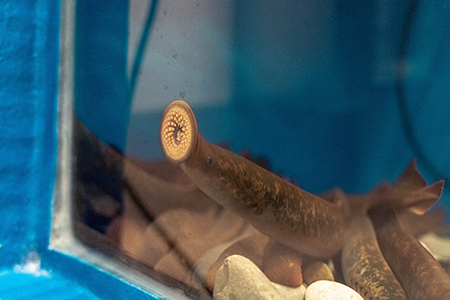
Native to the Atlantic Ocean and first introduced to the Great Lakes in the late 1800s, sea lamprey, sometimes referred to as “vampire fish,” are jawless, parasitic fish that have remained largely unchanged for more than 340 million years. Today, most of the research in the Great Lakes focuses on controlling the sea lamprey population, but Dr. Jones is instead using these fish to study human health.
Opioids, such as fentanyl, are nervous system depressants and, during an overdose, a person’s breathing often becomes compromised, Dr. Jones explained. Examining similar vessels in lamprey, he hopes to gain a better understanding of how this respiration is affected.
Naloxone, the active ingredient in Narcan, is administered via a nasal spray and can provide a quick reversal of the effects of an opioid overdose. But oftentimes, one dose may not be enough; according to Dr. Jones, there are reported cases where as many as seven doses of Narcan were needed to reverse the effects of a suspected opioid overdose.
“This is a huge strain when you consider most ambulatory services do not have an abundant supply of Narcan on board, or you have law enforcement officers that don’t have enough Narcan available,” Dr. Jones said. “Eventually there’s a point where you run out of Narcan, or you lose that individual. What our studies will hopefully do is be able to identify, for various novel fentanyl analogs, the amount of naloxone needed to reverse the effects of opioid overdose.
“We hope that our research will be able to really instruct, be a tool, a guide,” Dr. Jones added. “Research is really the only way we can begin to put the puzzle together.”
Learn more about Dr. Jones' research in the video below.