
A generous donation of $75,000 from Henry and Martha Upjohn is allowing a research team at WMU Homer Stryker M.D. School of Medicine (WMed) to continue its groundbreaking exploration into the cause of a common kidney disease.
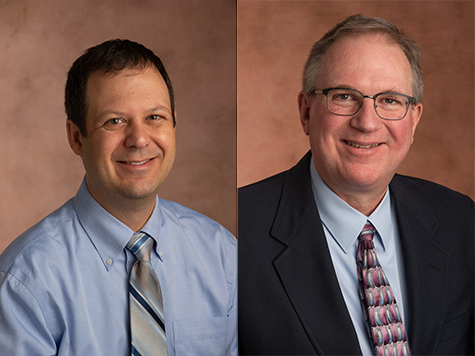
The research team, led by Erik Larson, PhD, and Gregory Vanden Heuvel, PhD, previously published results in Nature Communications explaining how Autosomal Dominant Polycystic Kidney Disease (ADPKD) emerges, a discovery that opens the potential for preventing what is currently considered an incurable ailment.
This most recent gift from the Upjohns will support further development of a “one-of-a-kind experimental model” of ADPKD that more accurately reflects human disease.
“While we consider the research important, to have the community put money behind it really speaks to the broad importance of this work to patients, and to the impact that it'll have outside of the laboratory,” said Dr. Larson, who serves as professor and vice chair in the Department of Biomedical Sciences. “External funding and gifts like this make the research possible.”
ADPKD is lethal, affecting one in every 400 to 1,000 people, according to the National Institutes of Health (NIH). It is one of the most common inherited diseases, and an affected individual will accumulate kidney cysts that eventually cause kidney failure.
ADPKD is caused by inheriting a non-functional PKD1 gene, but a cyst does not happen until the second working copy is turned off, a process called “second hit” inactivation.
“The Nature paper described the differences between the human and mouse PKD1 gene and why humans get ADPKD through this second hit, but we really didn't know how the second hit happened,” said Dr. Vanden Heuvel, professor in the Department of Biomedical Sciences. “Since then, we've generated a lot of data to provide a model for how the second hit happens.”
“Our prior findings revealed why, and now we’re working on how it’s happening,” Dr. Larson added. “Both pieces of information are essential for creating a preventative. That's what the field has been missing.”
The research team’s progress is particularly exciting for Dr. Vanden Heuvel, who has been studying ADPKD for more than three decades,
“Back then it was just, what can we do to slow down cyst growth?” Dr. Vanden Heuvel said. “Now, there’s a very real possibility that our research could prevent cyst development. That's where the research is going.”
Having donor support for this ongoing research is crucial, Drs. Larson and Vanden Heuvel agree, as “every penny is important to keep our lab going.”
“This gift comes at an important time, because you just don't have any guarantee that you'll be able to get grant funding, and when grant funding runs out, the research basically stops,” Dr. Vanden Heuvel said. “It's very, very, very important, and we're exceedingly grateful for this.”