
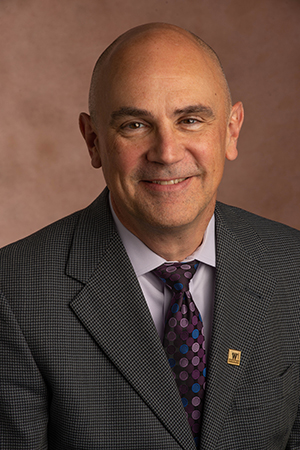
When he came to WMU Homer Stryker M.D. School of Medicine (WMed) more than a decade ago, David Riddle, PhD, says he was eager to grow as an educator and leader.
For Dr. Riddle, a longtime researcher and educator, the opportunity to help contribute to the growth of a new medical school was too good to pass up.
“That opportunity doesn't come along very often,” Dr. Riddle said recently. “At that point, I was taking a hard look at what I wanted to do for the last third of my career, and when I saw an opportunity to really focus on the educational side (of medicine), to be able to do that from the ground up and contribute to the initial growth of an institution was really exciting.”
Now, Dr. Riddle, professor and chair in the Department of Biomedical Sciences and assistant dean for Foundations of Medicine, is preparing to call it a career as he eyes retirement. His last day at WMed will be Tuesday, June 30, 2026.
Prior to joining WMed in 2014, Dr. Riddle taught and directed a neuroscience research laboratory for 18 years in the Department of Neurobiology and Anatomy at Wake Forest University School of Medicine. While at Wake Forest, Dr. Riddle served on and chaired several committees focused on medical student performance and professionalism, admissions and undergraduate medical education, as well as training graduate students and postdoctoral fellows.
Dr. Riddle is a graduate of the University of North Carolina where he was a Morehead (now Morehead-Cain) Scholar and earned a bachelor’s degree in zoology and the University of Michigan where he earned a PhD in neurosciences. Later, Dr. Riddle completed postdoctoral fellowships at Duke University Medical Center.
During his time at WMed, Dr. Riddle took on a variety of leadership roles in addition to those he currently holds, including serving as the inaugural chair of the Medical Student Performance Committee (MSPC) and as assistant dean for Academic Success, where he supported academic advising, monitored student progress through the MD curriculum, oversaw student remediation processes, and analyzed class performance, among other duties.
The inaugural MD Class of 2018 is particularly memorable for Dr. Riddle.
“Every class has been special, but that first class holds a place in my heart for the trust that they placed in us,” he said. “Seeing some of our early graduates now coming back as faculty members and as attending physicians in the community, seeing that hope and promise of the creation of the school beginning to be fulfilled is remarkable.”
Reflecting on his time at the medical school, Dr. Riddle said he is very grateful for the leadership opportunities he’s been afforded and immensely proud of the talented colleagues he’s had the chance to work with.
“We've built a really strong team in the Department of Biomedical Sciences here focused on the educational mission and on pursuing diverse research and scholarship,” Dr. Riddle said. “We've had great outcomes reflected in how our students have done on the step exams, how our students have done on the match. By all of the national metrics, I think we have achieved above expectations from the beginning, from that first inaugural class, across the institution.”
Looking ahead to retirement, Dr. Riddle said he is excited to spend more time with family, travel, and enjoy the great outdoors.
“I’ve greatly appreciated the opportunity here, and I’ve particularly enjoyed my colleagues in the department and on other teams that I’ve closely interacted with,” Dr. Riddle said. “I absolutely view my time at WMed as a very, very positive experience from start to finish.”