
Over the last decade, as high-profile cases brought to light the egregious sexual abuse of patients by former physicians like Larry Nassar and Robert Anderson, students at WMU Homer Stryker M.D. School of Medicine (WMed) posed an important question – how often do healthcare providers in Michigan face disciplinary action or, more specifically, lose their license to practice in the wake of serious criminal allegations?
The query brought about an intense search for elusive answers and the examination of more than 15,000 documents by faculty and students at the medical school. More importantly, it revealed an urgent need to strengthen regulatory frameworks and accountability measures at the state level.
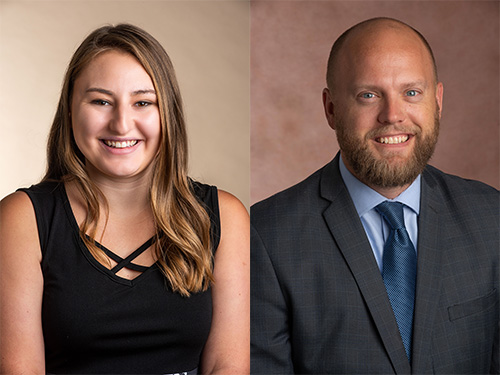
The findings are contained in the research article, “Sex, Drugs, and Continuing Education: Analysis of Professional Misconduct by Healthcare Licensees in Michigan (2011-2023,” co-authored by Nicole Alvarez, BS, a fourth-year student at WMed, and Tyler Gibb, JD, PhD, associate professor and co-chair of the Department of Medical Ethics, Humanities, and Law. The article was published in April in the Journal of Medical Regulation.
The research article is the result of an analysis by Alvarez and Dr. Gibb of more than a decade of healthcare disciplinary actions in Michigan using data from the Department of Licensing and Regulatory Affairs (LARA). As part of the examination, Alvarez, who has an undergraduate degree in bioengineering and extensive experience in managing large amounts of data, manually transferred and transformed information contained in thousands of static PDF records to build a structured and searchable digital database that the team used to understand trends in professional misconduct across 27 healthcare professions.
Their work has garnered accolades from the Federation of State Medical Boards (FSMB), which recently awarded Alvarez and Dr. Gibb the 2026 Journal of Medical Regulation Award for Distinguished Scholarship. They are set to be honored at a ceremony in Baltimore in May.
“It was really labor intensive but I loved working on it,” Alvarez said. “It became a passion for me and once we started getting results that were shocking, I thought this could mean something.”
In the article, Alvarez and Dr. Gibb highlight several key findings:
- Between 2011 and 2023, complaints filed with state regulatory boards rose 83.2 percent, while formal sanctions declined 3.6 percent -- despite a growing healthcare workforce.
- Negligence is widespread and cited in nearly half of all disciplinary actions.
- Sexual misconduct is under-addressed. Of 237 “sex-related” misconduct cases, only 4.6 percent resulted in permanent license revocation.
- There are disparities among professions. Some smaller professions (e.g., podiatry, massage therapy, nursing home administration) show disproportionately high rates of serious misconduct per capita.
- Education compliance lapses are prevalent. Over 18 percent of sanctions were for failure to complete required continuing education.
“This project and this publication tell the story of the problem, what we did, and what the data shows,” Dr. Gibb said. “And what it reveals is that it takes a lot to have your license permanently revoked. We found 12 cases total where that happened among more than 12,000 cases over a span of 13 years.
“You basically have to be Larry Nassar to have your license permanently revoked,” Dr. Gibb added. “You basically have to be a monster.”
Alvarez and Dr. Gibb found that between 2011 and 2023, 57,244 complaints were filed against healthcare providers in Michigan’s 27 regulated healthcare professions. Of those, 12,258, or 21.4 percent, resulted in formal sanctions. Also, over that same period, the total number of complaints rose by 83.2 percent from 3,478 in 2011 to 6,371 in 2023. Despite the substantial increase and a 34.1 percent increase in licensed providers (338,934 to 454,564) during that time, the total sanctions issued by LARA decreased by 3.6 percent from 746 to 720.
“Because there are more providers, I think it’s safe to assume there would be more cases of misconduct so I don’t understand why fewer sanctions are being issued,” Dr. Gibb said. “If the number of sanctions issued is correct then we have to assume that all of the new providers are perfectly ethical and don’t warrant sanctions, and also assume that the 80 percent increase in complaints contains a large number of illegitimate claims. I would like an explanation for the decrease in sanctions other than simple resource constraint.”
Alvarez and Dr. Gibb note in the research paper that high-profile cases like those of Nassar and Anderson illustrate how trust between patients and providers can be breached on a profound level. They also point out, though, that provider misconduct is a broad and pervasive issue that exposes systemic failures and erodes public trust across healthcare professions.
“Less publicized cases of serious misconduct, such as abuse of vulnerable patients, financial exploitation, sexual assault, and prescription drug misappropriation, are equally problematic,” they write. “Misconduct occurs in all health professions, highlighting the urgent need to strengthen regulatory frameworks and accountability measures.”
Alvarez and Dr. Gibb also point out in the article that, although publicly available, more transparency is needed when it comes to the overall accessibility of the disciplinary action reports (DARs) published by LARA. In their current form, the reports are difficult to search and analyze. A searchable database with standardized misconduct categories – similar to those in states like California and Delaware – would “enable better detection of patterns, identification of repeat offenders, and comparative analysis across professions and regions,” they contend
“Such reforms are essential for Michigan and other states to enhance their regulatory processes, which may protect the public and honor healthcare’s covenant of trust,” Alvarez and Dr. Gibb said in the research article.
While their research has highlighted major areas of concern, Alvarez and Dr. Gibb said their work also highlights several opportunities for state-level reform and real change. Among those reforms are:
- Modernizing LARA’s reporting systems to allow real-time tracking and public access similar to those in California and Delaware.
- Improving regulatory transparency and standardization across healthcare boards.
- Strengthening preventive education and ethics training for providers.
- Encouraging data-sharing partnerships between LARA, law enforcement, and public health researchers.
“Improving regulatory oversight of healthcare provider misconduct requires a multifaceted approach that incorporates the systematic improvement of the regulatory process, increased transparency in misconduct reporting, preventive education requirements, adequate resource allocation, and the establishment of collaborative information-sharing frameworks,” Alvarez and Dr. Gibb said.
Looking ahead, the important research by Alvarez and Dr. Gibb will continue with the goal of delving into healthcare provider misconduct trends in other states to determine if their findings are unique to Michigan or indicative of issues across the country and globally. They also want to explore rates of recidivism as their review of records in Michigan found numerous instances of repeat offenders.
They also hope future research will address limitations identified in the study, including the lack of availability of demographic data for healthcare providers who are sanctioned, as well as detailed information from the complaints filed by patients.
“This study is only the beginning,” Alvarez and Dr. Gibb said. “Our database has uncovered many more trends not yet published — including issues related to mental health, substance use, and board-to-board discrepancies — that will be the subject of future articles and policy briefs. Further, this dataset allows for complex interprofessional analysis that will yield many important additional contributions to the literature.”