
The medical school will welcome more than 70 resident physicians to Kalamazoo and Battle Creek this summer following a successful Match Day that saw the 10 residency programs at WMU Homer Stryker M.D. School of Medicine (WMed) fill nearly every available training slot.
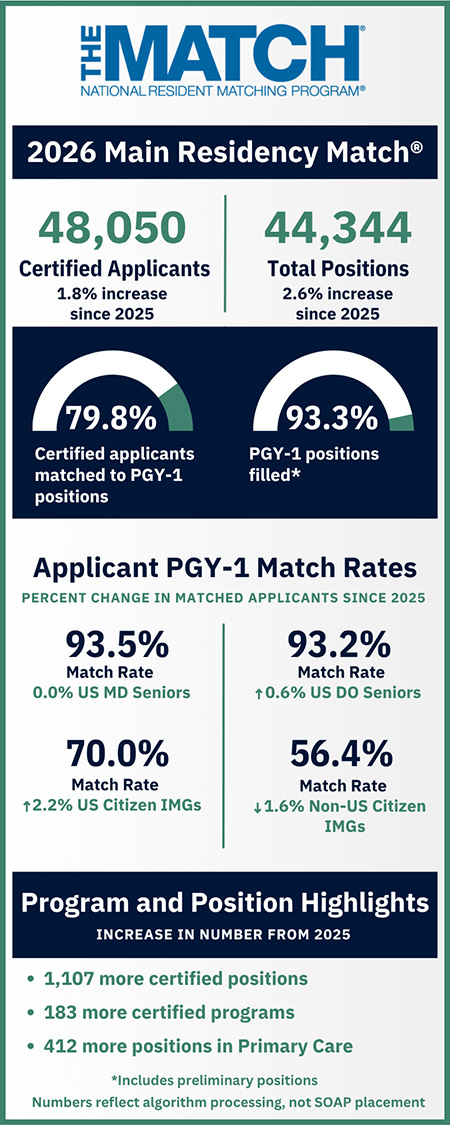
The results, announced on Friday, March 20, 2026, were part of the 2026 Main Residency Match, which was the largest on record, according to the National Residency Matching Program (NRMP). This year’s Match was made up of 53,373 registered applicants – 842 more than in 2025 – and 44,344 positions. Additionally, the number of available first-year (PGY-1) positions rose to 41,126, an increase of 1,085 from last year.
“We are thrilled to extend a warm welcome and congratulations to everyone who has matched into our graduate medical education programs at WMed,” said Kelly Brown, MD, associate dean for Graduate Medical Education. “As the newly matched residents and fellows join our community, we look forward to helping them succeed in their education and medical training.”
The new cohort of 75 resident physicians and six fellows includes four residents who are participating in MIDOCs, a program from the state of Michigan which expands residency training positions in select specialties. MIDOCs residents go on to practice in underserved areas of Michigan in exchange for loan repayment. The newest group of MIDOCs residents coming to WMed will join our Family Medicine-Kalamazoo, General Surgery, Internal Medicine, and Psychiatry residency programs.
In addition to Family Medicine, General Surgery, Internal Medicine, and Psychiatry, the medical school has residency training programs in Emergency Medicine, Medicine-Pediatrics, Obstetrics and Gynecology, Orthopaedic Surgery, and Pediatrics as well as fellowships in Emergency Medical Services, Forensic Pathology, Hospice and Palliative Medicine, Medical Simulation, and Sports Medicine.
The new residents will begin their training in July. The medical school will also welcome new fellows to its EMS, Forensic Pathology, Hospice and Palliative Medicine, and Sports Medicine fellowship programs.
The group of new resident physicians includes seven students from the medical school’s MD Class of 2026. The students were part of a class that saw 98 percent of its students enter a residency program in specialties ranging from Family Medicine and General Surgery to Internal Medicine and Pediatrics.
Match Day is a time-honored tradition held at medical schools across the country. It represents a life-changing moment for graduating medical students as the course of their medical careers is determined and they learn where they will spend the next three or more years for residency training. Residents practice medicine in a clinical setting under the supervision of fully licensed physicians.
The Main Residency Match process begins in the fall for applicants usually in the final year of medical school, when they apply to residency programs at which they would like to train. Program directors review applications and conduct candidate interviews in the fall and early winter. From mid-January to late February, applicants submit to NRMP their rank order lists of preferred programs, and program directors rank applicants in order of preference for training. The NRMP uses a computerized mathematical algorithm to match applicants with programs using the preferences expressed on their rank lists.
About the NRMP: The National Resident Matching Program® (NRMP®) is a private, non-profit organization established in 1952 to oversee The Match®. The Match was established at the request of medical students to provide an orderly and fair mechanism for matching the preferences of applicants for U.S. residency positions with the preferences of residency program directors. In addition to the annual Main Residency Match® for more than 48,000 registrants, the NRMP also conducts Fellowship Matches for more than 70 subspecialties through its Specialties Matching Service® (SMS®).