
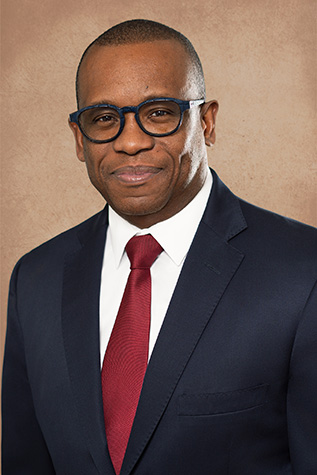
The Hal B. Jenson, MD Dean
President and CEO
In nearly every office he’s occupied during an almost three-decade journey in academic medicine, J. Adrian Tyndall, MD, MPH, FACEP, keeps the same chess board on display.
It’s a collector’s item – the pieces on each side representing Major League Baseball’s American and National leagues – that was given to him by his best friend’s father. The set is an ode to Dr. Tyndall’s love of chess and sports, and over the years he says it has served as a conversation starter, a way to connect.
In years past, he often kept running games going – contests of “one play a day” – with different faculty and staff at the institutions where he has worked.
“The chess board serves as a constant reminder to always look ahead,” Dr. Tyndall explained. “Life is like a chess game – you’re only as successful as your ability to anticipate several moves in advance. These strategic lessons not only influence the decisions I make in my professional life, but even more so at the institutional level. Ultimately, what inspires me most is fostering relationships and collaborations, and helping people discover and pursue their passions so they can contribute meaningfully.”
That outlook is at the forefront for Dr. Tyndall as he officially takes the helm today as the Hal B. Jenson, MD Dean, President, and CEO of WMU Homer Stryker M.D. School of Medicine (WMed) following more than four years at Morehouse School of Medicine in Atlanta where he served as dean and executive vice president for health services, and in his prior roles as Interim Dean and Associate Vice President at the University of Florida and UF Health.
At this stage in his career, Dr. Tyndall reflected that the opportunity to lead an institution like WMed – one that places health equity at its core through innovation in medical practice and education – not only excites him, but also resonates deeply with his values as a physician, leader, and educator. He described leading WMed, where health equity is a foundational principle, as a rare and meaningful privilege. With all the essential elements in place, Dr. Tyndall believes WMed is poised to make a lasting, positive impact on the health of communities across Southwest Michigan. The pursuit of health equity – ensuring that everyone has the chance to be as healthy as possible – has guided him throughout his medical career.
Dr. Tyndall, 56, traces his roots to Guyana on the northern coast of South America. He spent his formative years in the Washington, D.C. area, graduating from Walt Whitman High School. As the middle child and only son, he fondly recalls his mother, an English teacher and passionate music enthusiast, often playing cassette recordings of “The Chopin I Love” performed by Arthur Rubinstein, the renowned Polish-American virtuoso pianist and one of the greatest interpreters of Chopin in the 20th century. The soothing melodies became a cherished part of his bedtime routine, instilling in him a lifelong appreciation for music.
Dr. Tyndall began taking piano lessons at the age of five, minored in piano performance in college, and has continued to take piano lessons on and off for the last 35 years. Over the years, he has taken pride in having retained the talent of perfect pitch. His love of music, especially as an amateur pianist, has provided him with a life balance and a refuge from the rigors of his work. It has also fueled his passion for the emerging movement of the arts in medicine and health. For example, at the University of Florida, where Dr. Tyndall served as the chair of the Department of Emergency Medicine for more than a decade, he championed a program in which musicians from the UF Health Shands Arts in Medicine program visited the hospital regularly to play for patients in their rooms as a way to harness the healing power of live music.
“I’ve always looked for ways to blend medicine with music,” Dr. Tyndall said. “The program made a meaningful difference for patients, staff, and musicians alike.”
Recently, Dr. Tyndall joined the inaugural working group of the NeuroArts Academic Network (NAN), a global initiative advancing the science of arts in health. NAN, launched through a partnership between Johns Hopkins’ International Arts + Mind Lab and the Aspen Institute, unites leading universities, institutions and community organizations to shape NeuroArts through research, education, and policy.
Dr. Tyndall recounted his early childhood experiences with music when he performed a classical work from the Rubinstein album at the Atlanta Symphony Hall as part of a kick-off celebration of a new Arts and Medicine Initiative in Atlanta, Georgia, in October 2025.
“Everyone looks for some space where there’s capacity for resilience, and space where you can retreat and recover and refresh,” he said. “For me, that’s partly music.”
Dr. Tyndall’s early years were shaped by a deep curiosity and a passion for both music and science, inspired by his love of science fiction novels and his dreams of pursuing careers in both fields. Yet, it was the profound impact of personal loss that ultimately steered him toward medicine. As a young boy, he witnessed a close relative experience what he later understood to be a massive and immediately fatal intracerebral bleed – an event he can still vividly recall, tracing its clinical progression in detail. Then, at age 16, while a freshman at George Washington University, he endured the loss of his grandmother after months in a coma, following a catastrophic medical error at a hospital in Washington, D.C. Reflecting on these tragedies, Dr. Tyndall remembers being compelled to intervene, wishing he could help, but also grappling with a powerful sense of helplessness. These formative experiences propelled him to pursue medical school, determined to make a difference for others facing similar moments of crisis.
After he earned his MD degree from the University of Maryland School of Medicine, Dr. Tyndall began his Emergency Medicine residency training at the University of Maryland Medical Systems where he served as chief resident. His decision to pursue Emergency Medicine, he said, stemmed from the experiences and relationships he gained when he worked as a nursing assistant and EMT in the emergency room at the GWU Hospital.
Reflecting on his formative years, Dr. Tyndall recalls the profound impact of his time in the emergency room at GWU, where he witnessed the extraordinary passion, skill, and humanity of the staff.
“Their ability to cope admirably under the severest of circumstances, to handle human tragedy with grace, and always show compassion and empathy at every instance – I wanted to be that,” he shared.
The GWU Emergency Department not only introduced him to academic emergency medicine and clinical teaching but also taught him invaluable life lessons during his late teens. Pivotal to his decision to pursue academic emergency medicine were his experiences at the University of Maryland and the close mentorship of the late Dr. Elizabeth Tso, along with many faculty at the University of Maryland Medical Center’s Department of Emergency Medicine. Their guidance and leadership helped shape his career and solidify his commitment to the field.
Over the span of his time in medicine, Dr. Tyndall has established himself as a nationally recognized academic leader, educator, and physician executive whose career includes academic medicine, clinical practice, transformative contributions to medical education, health system leadership, and academic emergency medicine. His career path has included academic appointments at State University of New York Health Science Center at Brooklyn School of Medicine, Weill Medical College of Cornell University, and New York University School of Medicine. He recalled early in his career his time as a residency program director in New York when he made what he called a “fateful decision” to leave academic medicine for community practice with the hope that the move would allow him to spend more time with family.
Time away from academic medicine, Dr. Tyndall said, helped make him a better physician and leader.
“That time away clarified for me where my passions truly lay, which was in teaching, in being part of the academic environment, in being part of that environment of inquiry,” Dr. Tyndall said.
He served as chair of the Department of Emergency Medicine at the University of Florida and was later appointed interim dean of the UF College of Medicine, leading the college through the challenges posed by the COVID-19 pandemic.
He left Gainesville in 2021 to become the executive vice president for health services and dean at Morehouse School of Medicine.
When he thinks about the success he has had during his career, Dr. Tyndall credits his family for serving as his inspiration while also helping keep him grounded. He also reflects fondly on the wisdom of his parents, their focus on education, and the fervent Christian faith of his maternal grandmother that served as the foundations and guides for his life.
“The most significant leadership lessons I learned came from observing my mother,” Dr. Tyndall said. “She was gifted and brilliant in the art of disarmament and negotiation and I find her lessons useful in how I navigate my way through the twists and turns of leadership … I have those sets of values and that faith to lean into and guide me.”
Dr. Tyndall’s selection as the next dean, president, and CEO of WMed came in November following a national search. As he begins to chart his path at the medical school, Dr. Tyndall had a simple response when asked what excites him most about his new role.
“Meeting and learning from people,” he said. “It’s how I will get to know the WMed community and Kalamazoo.”
In his first 100 days, Dr. Tyndall said he plans to connect with numerous stakeholders at the medical school, including his executive team, faculty, students, residents, fellows, staff, and community partners. He wants to listen, ask questions, learn, and build relationships. And he said he will approach the work ahead of him with a strong focus on fueling the momentum to help achieve WMed’s vision of health equity for all in the region.
“I view my role as one in which I help to integrate a vision and mold consensus around that vision,” Dr. Tyndall said. “Part of that, for me, is leading with humility, which means that there is a sense that I can absolutely be approached by anyone who has a perspective or insight because they understand my willingness to listen.”
Dr. Tyndall said he will work to forge strong relationships in the community, including those with the medical school’s three collaborators – Western Michigan University, Beacon Health, and Bronson Healthcare.
“I believe there’s significant potential for community engagement that must be realized,” Dr. Tyndall said. “We have an extraordinary opportunity to elevate the entire community in terms of health, health outcomes, impactful research, education, and workforce development. There are remarkable elements within the community that, when brought together, can help us fulfill our vision. I truly enjoy immersing myself in this collaborative process to make that happen.”
Dr. Tyndall began making connections with some community partners shortly after his selection as the dean, president, and CEO. In December, he traveled to Ford Field in Detroit and watched the WMU Broncos bring home a MAC Championship and got the chance to meet members of the WMU Board of Trustees, as well as local government officials.
Now that he’s officially arrived in Kalamazoo, Dr. Tyndall has amassed a to-do list for outside of the office to familiarize himself with the community and region. He and his family have plans to visit Lake Michigan to experience some of the lakeshore’s beautiful beaches and sand dunes for the first time. They’re also looking forward to connecting more with close relatives in Chicago and Dayton, Ohio. An avid cyclist, he also wants to hit the Kal-Haven Trail.
“I’m excited to be here, to be a part of this community, and do the work,” he said. “Embracing this notion of what health equity means for Southwest Michigan is really important to me and I know this is work we can do.”
And, as that work begins today, the chess board and its pieces will be with Dr. Tyndall as he takes his seat in his office at the W.E. Upjohn M.D. Campus for the first time as dean.