
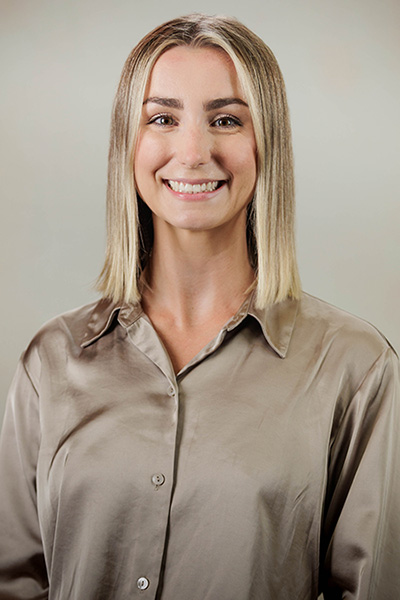
After an unexpected spinal cord injury during surgery left her mother paralyzed in 2020, M1 Madeline Shoemaker says her entire family wrestled endlessly with the tough questions of why.
“She always asks herself, ‘Why did this happen to me, why did this happen to our family?’” Shoemaker recalled recently.
The answer, in some ways, can be found in the events that followed her mother’s surgery, Shoemaker said.
Today, Shoemaker is in medical school and pursuing her MD degree at WMU Homer Stryker M.D. School of Medicine (WMed) because of what happened to her mother. She’s also become a fierce advocate for improving accessibility in healthcare for patients with disabilities, a passion fueled from witnessing her mother’s own struggles over the last five years during regular visits to the hospital and with her physicians.
“We say all of this happened for a reason and now I’m in medical school and pursuing my MD degree,” Shoemaker said. “Her experience has opened all of our eyes and led to a bigger meaning.”
Before she arrived to WMed in July as a member of the MD Class of 2029, Shoemaker attended Fort Lewis College in Durango, Colorado, where she earned a bachelor’s degree in biochemistry in 2023. After graduation, she spent two years in her hometown of Phoenix, Arizona, working as a medical scribe in the office of an orthopaedic surgeon who treated a range of patients, including some with cerebral palsy and spina bifida.
“I gravitated toward – and felt more impacted by – our patients with cerebral palsy and spina bifida,” Shoemaker said. “It really solidified my desire to advocate for patients with disabilities and it gave me experiences outside of those just with my mom.”
Shoemaker said she chose WMed to pursue her MD degree, in part, because her parents are originally from Michigan and her grandparents live in Fenton and Olivet. She also has aunts and uncles here.
When she applied for medical school, Shoemaker said she appreciated the big emphasis WMed placed on its students volunteering in – and connecting with – the community. She hoped to use that unique aspect about WMed to volunteer her time at Disability Network Southwest Michigan (DNSWM), a local organization with offices in Kalamazoo, Battle Creek, and St. Joseph that is dedicated to empowering and supporting individuals with disabilities so they can achieve their full potential.
Once she arrived in Kalamazoo, Shoemaker was able to quickly connect with leaders at DNSWM through the medical school’s Engagement and Discovery program, a 17-month endeavor that begins for students during their first year at the medical school. The course focuses on equipping WMed students with the core concepts around healthcare systems integration and understanding the best ways to work with the community.
In August, Shoemaker met with Miranda Grunwell, community education program manager at DNSWM, and that initial meeting allowed Shoemaker to learn more about the organization and the resources it offers for local residents with disabilities. It was also at that meeting that Grunwell proposed the idea of Shoemaker hosting a future webinar on a topic related to disability advocacy.
“I chose increasing access in healthcare because it’s a very prevalent topic and it’s important for me as a future physician, as well,” Shoemaker said. “(Miranda) gave me total free reign on my creativity and what topic I wanted to choose.”
From there, Shoemaker worked with Grunwell to do research for her webinar and met monthly to discuss progress on the project.
Then, on December 3, 2025, Shoemaker hosted “Beyond the Ramp: Reimagining Accessibility in Healthcare,” a one-hour webinar that was attended by several people, including clients from DNSWM.
The webinar covered an array of topics and sought to emphasize why accessibility matters for patients with disabilities when they visit their physician’s office or the hospital.
Shoemaker highlighted physical barriers in healthcare such as inaccessible mammography machines, the absence of accommodating weight scales, and non-adjustable exam tables. She also discussed communication barriers such as videos for patients that have no captioning or the lack of braille or options for patients who use screen readers. She also highlighted systemic barriers in healthcare including insurance, the lack of mandatory disability training for healthcare providers, and inaccessible scheduling policies.
Shoemaker also provided possible solutions to the barriers during the webinar, including the need for healthcare providers to ensure that patients with disabilities have access to screen readers and are able to easily provide feedback following a visit. She also said medical offices can be made more accessible with the implementation of adjustable exam tables, wide doorways, and transfer equipment, among other things.
“I thought it went really well,” Shoemaker said. “My goal was to have people participate in the webinar. We had DNSWM clients in the webinar and I really wanted to hear about their experiences and I wanted to hear their stories.”
Shoemaker said she walked away from the webinar herself more knowledgeable and equipped with more potential resources to improve healthcare accessibility, including a “healthcare resumé” that was created by the leader of a chronic pain support group at DNSWM. The resumé is a tool that clients from DNSWM can use to give providers a quick list of their existing medications and conditions so medical appointments are more efficient and focused more on present issues and less on the review of patients’ medical histories.
Since the webinar, Shoemaker said she has collaborated with the group leader to improve the resumé and added a section to the document for patients to include their medical imaging, if needed.
Shoemaker also received positive feedback from webinar attendees.
“It’s great to see young medical students getting involved with patients and our concerns,” one person said in a post-webinar survey.
As she looks ahead, Shoemaker said she plans to continue volunteering her time at DNSWM and has already talked with Grunwell about hosting future webinars. She also wants to work more closely with student interest groups at the medical school to raise awareness among learners about the need for better accessibility in healthcare for patients with disabilities.
After medical school, Shoemaker said her advocacy for that increased accessibility will continue when she’s a resident and throughout her career. And her passion for her work as a physician and as an advocate will continue to be driven by her experiences with her mother, she said.
“She shaped my decision to go to medical school and to advocate for patients with disabilities because they are an underrepresented group,” Shoemaker said. “I think the big thing is seeing her in vulnerable situations and the responsibility that a physician takes on to help patients like my mom who aren’t able to advocate for themselves and need a physician or someone in a leadership role to advocate for them and their health.”